
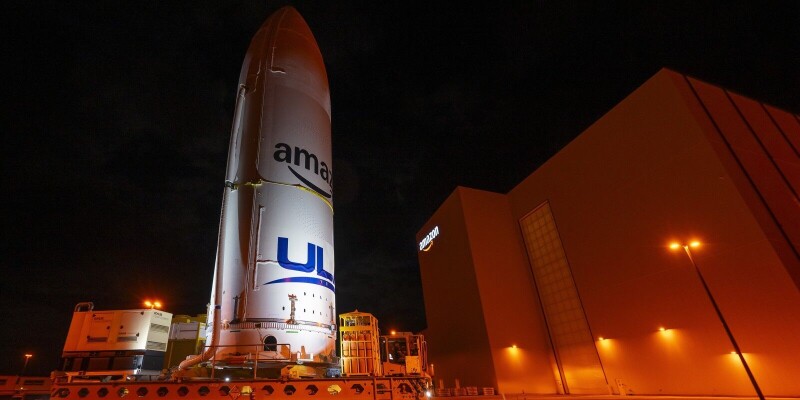
United Launch Alliance (ULA) says poor booster performance appears to have doomed Sunday's Vulcan mission, which lost an Amazon Leo satellite payload on the rocket's return to flight.
ULA's initial assessment points to trouble almost immediately. "Early indications are that just after liftoff the launch vehicle experienced low booster performance," it said. As a result, stage separation occurred at too low an altitude, and the rocket was not traveling fast enough for the payload to reach orbit.
The second stage appeared to perform well, with its RL10 engines operating as planned, but that wasn't enough to make up for the shortfall, and the mission failed. ULA lost telemetry approximately ten minutes into flight.
An investigation is underway, led by ULA and overseen by the US Federal Aviation Administration (FAA), which had to activate two Debris Response Areas where debris was falling. The agency directs aircraft to leave these areas, and others are prevented from entering.
Previous flights had been blighted by problems with the solid rocket boosters, designed to give the rocket a kick at launch. Those issues prompted a stand-down while investigators examined the cause. This time, ULA said: "All indications are that the solid rocket booster performance was nominal, following nozzle improvements implemented for this launch."
Attention therefore turns to Vulcan's liquid-fueled core stage, powered by two Blue Origin BE-4 engines, though that does not establish an engine fault. Fuel delivery or another first-stage system could also be responsible, and the investigation is ongoing.
The BE-4 also powers Blue Origin's New Glenn rocket, which exploded on the launchpad during a ground test in May. In August, Blue Origin boss Dave Limp said that the issue originated at the main oxygen valve on one of the BE-4 engines. Modifications were made to deal with the problem.
The upper stage's apparently normal performance may offer some reassurance to NASA, although the investigation remains at an early stage. The agency dropped the delayed Exploration Upper Stage earlier this year and is pursuing a stretched Centaur V alongside its existing interim cryogenic propulsion stage as options for Artemis IV.
NASA is targeting Artemis IV for early 2028 and Artemis V for later that year.
ULA said: "We truly understand the impact this has on our customers and are committed to returning to flight as safely and quickly as we can."
The failure also dents ULA's otherwise impressive launch record. A predecessor of Vulcan, the Atlas V, has a 100 percent success record for payloads reaching orbit. However, it uses Russian RD-180 engines, a dependency the US wishes to remove. ®


